
Typed, scored, HNSW-indexed.
Every memory is owned by a user, typed across 8 categories, scored for importance and confidence, embedded with gemini-embedding-2-preview at 768 dimensions, and indexed in pgvector with HNSW.
AI systems architect. Works in Claude Code every day. Builds production agents, dual-store memory systems, and multi-product platforms as a team of one.
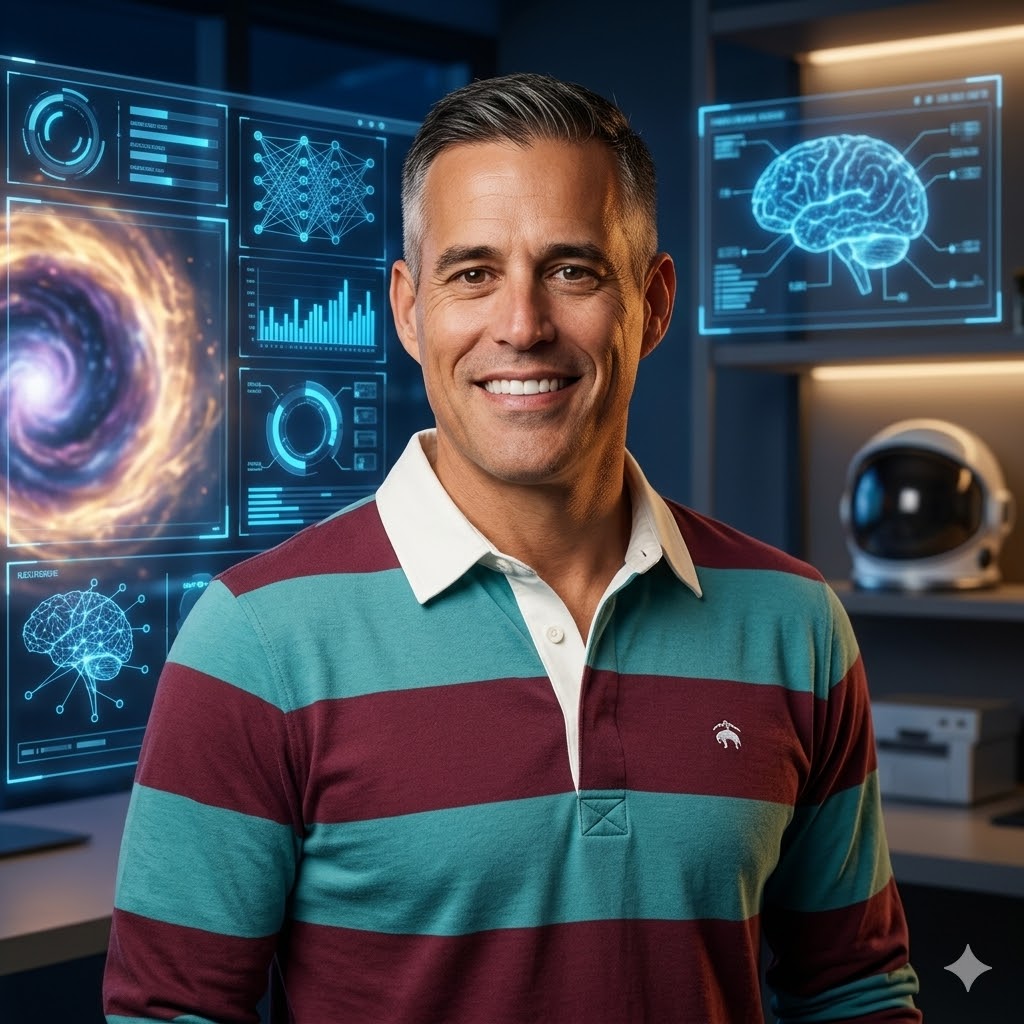
Glen runs Nuclear Marmalade, an AI product company he operates solo from Tampa, Florida, with a swarm of agents as his team. The company ships four products in parallel: Nuclear Directories (a US business directory with 10M+ records and nightly automated page builds), Buzzy Bets (a prediction engine running on transformer sequence models and Kelly sizing), Telehance (AI-first telecom brokerage), and Forge (the enrichment pipeline underneath it all). All four run on infrastructure he designed, built, and maintains himself.
The throughline in Glen’s career is closing the gap between a person and what they’re trying to do.
He started in the US Army in 1999. First as a military police investigator in Hawaii, then as a recruiter in New Jersey, where he finished top 10% worldwide and earned the US Army Recruiter Ring. Eight years in, he got out, went to Rider University on the GI Bill, and graduated cum laude in multimedia communications.
Ten years of enterprise B2B sales followed. Verizon Business, then Comcast Business where he took over a Nashville team and built it into a top-five performer nationwide, then ADP.
Then COVID. Then his wife died giving birth to their fourth son. And the life that made sense before didn’t make sense after.
Glen stepped away from sales and took a job teaching sixth-grade English. Not as a pivot. As a reset.He needed to be closer to his four young boys in the shadow of their mom’s absence. Something closer to the ground.
His students had spent formative years behind screens, and it showed in their writing. Not in their ideas, which were as wild as any sixth grader’s ideas have ever been. In their ability to get those ideas onto a page in a way another person could feel. The gap wasn’t imagination. It was articulation.
One afternoon, on a hunch, Glen pulled up Midjourney and started generating AI images from his students’ sentences and showing them back to the class: this is what your writing looks like to someone else. The room changed. Kids who had been stuck started revising. They could see the distance between what they meant and what they’d written, and they closed it themselves.
AI as a mirror for imagination.
That was the moment. Not an edtech revelation. Something smaller and more honest. A tool that could let people build what, until then, only existed inside their heads. That afternoon became the seed for Write With Riley, still on the Nuclear Marmalade roadmap. More importantly, it was the moment Glen committed to AI as the rest of his career.
He returned to telecom sales to pay the bills. Frontier, then Spectrum. But the real work was happening at night. The first problem he hit was the one everyone hits: ChatGPT has no memory. Every conversation starts over.
So Glen went deep. He taught himself vector databases, embedding models, retrieval architectures, token-budget ranking, memory-type weighting. The first system was naive. The second was better. The eighth became Nukaplakia.
He set out to build a second system he’d been sketching on paper for weeks: an inference layer that noticed when unrelated signals from different domains started clustering around the same thing. He called it Convergence Detection. Six engineering phases, shipped in a single week in March 2026. A sharp analyst might notice this kind of signal by accident after a decade on the job. Nuke does it on a schedule.
In March 2026, Glen left Spectrum and committed to Nuclear Marmalade full-time.
What “memory” actually means when you wire it into a production agent that runs every day.
Every memory is owned by a user, typed across 8 categories, scored for importance and confidence, embedded with gemini-embedding-2-preview at 768 dimensions, and indexed in pgvector with HNSW.
Full-text (BM25) and semantic (<=>) search run in parallel, then re-rank by memory type. Corrections 1.5×, preferences 1.3×. Supersede links demote stale facts without deletion.
Every Postgres write dual-writes to Hindsight with an ownership token. Recall fuses Hindsight’s 4-signal ranking (entity overlap, BM25, entity graph, temporal) into Postgres results under a 60/40 token budget. Full-text + pgvector fallback keeps the agent responsive if Hindsight drops.
Hindsight is a shared bank. Ownership verification happens on recall, not in storage. No cross-user leakage is possible even when the shared store ranks a different user’s document.
An agent that notices what its user can’t: when signals from unrelated domains start pointing at the same thing. Six engineering phases, shipped in a week.
Each emits typed signals into a shared signal bus with 6-hour, 24-hour, and 7-day sliding windows. Model edges, client inquiries, revenue spikes, calendar windows, competitor moves.
Entity overlap (0.40), temporal proximity (0.30), causal chain match (0.15), pattern template match (0.15). Clusters expand recursively with cycle protection, cap at 50 to prevent runaway.
A “business play” fires when a new business shows up in a category already on the radar, within a calendar window the user has free. Templates were designed before the engine, not discovered by it.
Every convergence becomes an LLM-generated card: title, 2-to-3 sentence narrative, 2-to-4 action steps, confidence label, time window. Persisted, user-scoped, injected into Nuke’s context before every chat turn.
Designs and ships production agents that plan, tool-call, remember, and escalate. Advanced Tool Use patterns drop token spend roughly 95% versus naive loops.
Writes the orchestration, the dedup, the ownership-verified retrieval, and the ranking. Not a wrapper. Not a vector DB with a prompt.
Ships MCP integrations for Gmail, Calendar, Drive, Notion, iMessage, Telegram, Playwright, filesystem. Open-sources the skills that sharpen his own work.
Postgres, pgvector, Redis on Railway. FastAPI. Next.js 16. React 19. Claude Code as collaborator, not autocomplete. Wake up, build, learn, ship.
Consulting, custom builds, and senior or principal AI engineering roles. Open to remote. Open to relocation for the right team.
Get in touch