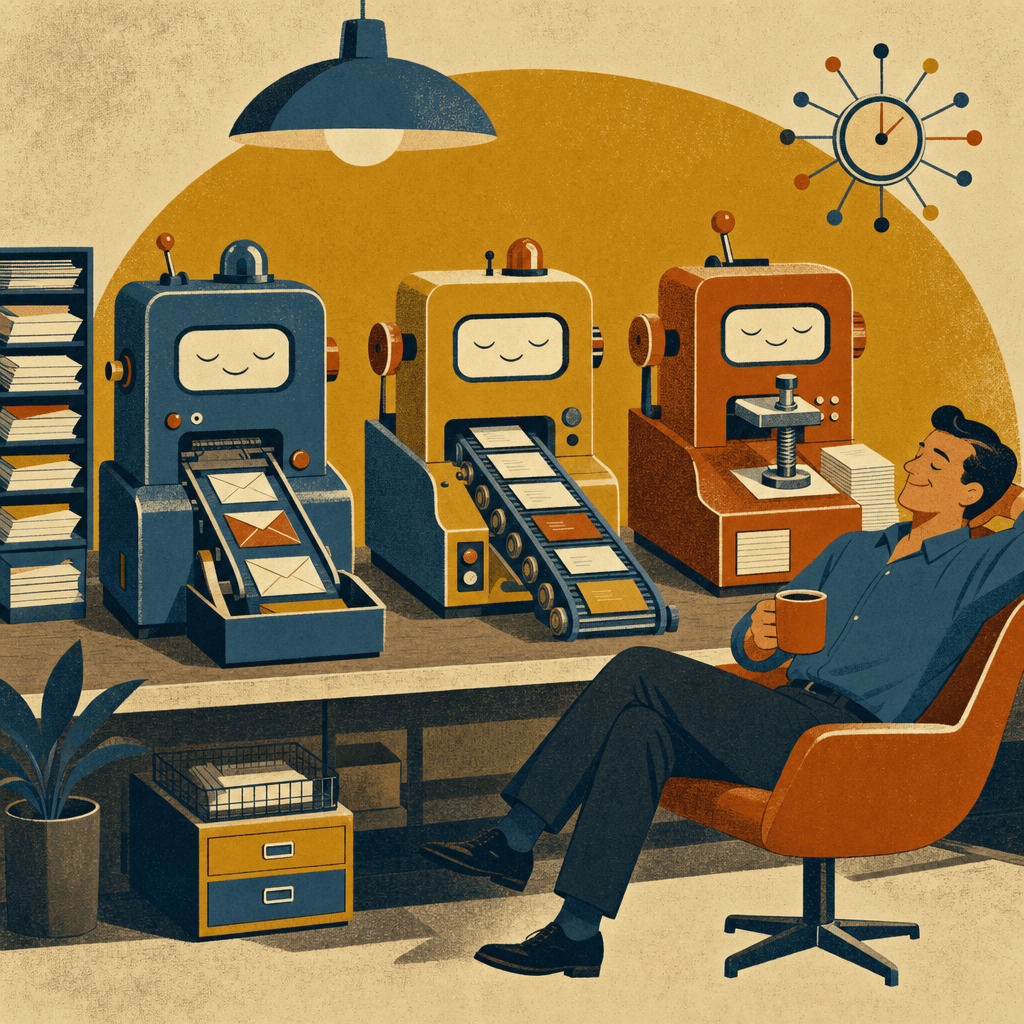

Most service businesses don't have an automation problem. They have a prioritisation problem. They build the shiny stuff first — dashboards, chatbots, AI summaries — and leave the unglamorous work running on human effort and hope. At Nuclear Marmalade, we've seen this pattern enough times to name it: automation theatre. You look productive. Nothing actually changes.
The three automations that move the needle aren't complicated. They're the ones that touch your business every single day — lead intake, follow-up, and delivery handoffs. Build these three first and everything else gets easier.
Why does lead intake automation matter so much?
Lead intake automation matters because the window between someone expressing interest and them choosing a competitor is brutally short — often under an hour. If your intake process involves a human reading an email, copying details into a spreadsheet, and then deciding what happens next, you're losing deals you never knew you had.
The fix isn't complicated. A form submission or inbound email triggers an automated workflow: contact gets created in your CRM, lead details get categorised by service type, an acknowledgement goes out instantly, and the right person gets notified with full context — not just "someone filled out the form." We built exactly this for a consulting client who was handling intake manually. Their average response time dropped from 4 hours to under 6 minutes. They closed 22% more leads in the following quarter without hiring anyone new.
The honest version of this advice: most people build intake automation that serves themselves, not the prospect. They automate the CRM entry but forget the acknowledgement email. The prospect is left wondering if anyone's home. Build it from the prospect's experience backward.
Why does follow-up automation matter — and why do most businesses skip it?
Follow-up automation matters because most service businesses lose revenue not from bad leads, but from leads they simply forgot to chase. The manual follow-up system — sticky notes, calendar reminders, a brave optimism that you'll remember — fails constantly. It fails when you're busy. Which is always.
Automated follow-up sequences aren't about being annoying. Done right, they're genuinely useful. A prospect who enquired about your service three days ago and heard nothing probably hasn't moved on yet — they're just waiting for someone to show they give a damn. A well-timed, contextual follow-up does that without requiring your brain to remember anything.
We've seen this built badly, too — and Glen Healy will be the first to admit we got it wrong early on. We once built a follow-up sequence for a client that was too aggressive — five emails in seven days. Unsubscribe rates spiked. Lesson learned: two or three well-spaced touches outperform five desperate ones every time. The sequence needs to feel like a thoughtful person sent it, even though a machine did.
If you want to see how we approach this kind of build, our contact page is the fastest way to start a real conversation.
What is a delivery handoff, and why should it be automated?
A delivery handoff is the moment a new client moves from "sold" to "being served" — and it's where most service businesses quietly haemorrhage trust. The sales team knows everything about the client. The delivery team knows almost nothing. Someone has to bridge that gap, and right now it's probably a frantic Slack message or a meeting that shouldn't need to exist.
Automating the handoff means the moment a deal is marked won, the delivery team receives a structured briefing — client name, service purchased, key context, timeline, any promises made during the sales process. No chasing. No dropped details. The client experience feels seamless because the information flow actually is.
This is unglamorous work. Nobody puts "automated handoff" in a case study headline. But the businesses that get this right — really right — retain clients longer because those clients feel looked after from day one, not just day thirty when someone finally figures out what they bought.
You can see how this thinking shows up in our actual client builds by looking at the Telehance project, where operational handoffs were a core part of what we built.
How do you know which automation to build first?
The honest answer: build whichever one hurts most right now. That's not a cop-out — it's the most useful prioritisation framework there is. If you're losing leads before they ever become prospects, intake is your first build. If your pipeline is full of warm contacts nobody's chasing, follow-up is bleeding you. If your team spends the first two weeks of every engagement figuring out what they're supposed to be doing, handoff is the culprit.
The mistake most businesses make is trying to build all three at once. You end up with three half-finished automations that don't talk to each other and create more confusion than they solve. Pick one. Build it properly. Measure what changes. Then move to the next.
At Nuclear Marmalade, we typically recommend starting with intake — because it's the top of everything. Fix the front door first. You can refine the rest of the house later.
If you're unsure which problem is costing you most, the work we've done for other service businesses gives a decent sense of how we think through these decisions.
What does a realistic automation build actually look like?
Realistic automation builds are smaller than most people expect and more impactful than most people hope. They're not six-month projects. A properly scoped intake automation can be live in two weeks. A follow-up sequence, maybe one. A delivery handoff workflow, two to three weeks depending on what your CRM can do natively.
What makes them take longer than they should, in our experience, is unclear ownership. Someone has to decide what the rules are — who gets notified, when, with what information. The automation is easy. The decision-making behind it is where projects stall. We've had builds sit in limbo for four weeks because nobody could agree on which team owned a lead after the first call. That's not a technology problem.
The practical advice: before you build anything, document the current process exactly as it happens — not how you wish it happened. Map every handoff, every decision point, every "it depends." That document is worth more than any tool you'll buy. It's also the thing most people skip entirely because it feels like admin. It isn't. It's the foundation.
You can read more about how Glen Healy has approached these kinds of operational builds on the founder page.
Key Takeaways
- Intake, follow-up, and delivery handoffs are the three automations that actually move revenue — everything else can wait
- The window between a lead expressing interest and choosing a competitor is often under an hour; manual intake can't compete with that
- Follow-up sequences work best when they feel human — two or three contextual touches outperform five desperate ones
- Handoff automation isn't glamorous, but it's where client retention is quietly won or lost in the first two weeks
- Build one automation properly before starting the next — three half-finished workflows create more chaos than zero
If any of this sounds like your business right now, get in touch — we build these kinds of systems for service businesses and we're pretty good at making them actually work.